Category Archives: Uncategorized

South Africa’s Truth and Reconciliation Commission: The Ongoing Demand for Economic and Social Equity

Failure Number One: When South Africa’s new democratic constitution emerged from the Truth and Reconciliation Commission (TRC) negotiations, it was meant to usher in prosperity for the country’s Aboriginal communities. But despite the dismantling of apartheid, the TRC failed to include any true reparations for South Africa’s original people. Land remains unreturned, and an estimated 73% of commercial farmland is still controlled by white farmers.

As far as REAL property is concerned, the ANC must inform white farmers and other white landowners that if they want to retain their properties, they must provide a deed of sale documenting that they purchased the land from the original owner! Otherwise, the ancestral lands and properties will be considered stolen and returned to the South African Aboriginal people.

The TRC, composed of three committees—Human Rights Violations, Reparation and Rehabilitation, and Amnesty—set the stage for storytelling but not accountability.

What kind of revolution leaves its wealth and natural resources in the hands of former oppressors? The outcome was a structure that reinforced corporate control by a handful of white-owned firms, entrenching economic inequality even as political power shifted.

In the haunting words of Archbishop Desmond Tutu:

“Your dignity is not just rubbed in the dust. It is trodden underfoot and spat on. Our people are being killed as if they were but flies. Is that nothing to you who pass by?”

Fact: Every Aboriginal South African should have been recognized as a victim by the TRC. But instead of the full truth, the Truth and R Commission offered partial acknowledgment and withheld justice. Forgiveness was expected, without accountability.

More than 21,000 people, mostly Aboriginals, told their stories before the Commission, accounting for nearly 38,000 human rights violations. Yet, millions remain unnamed, unheard.

Even under the African National Congress (ANC), which has held power for over four decades, white privilege has largely endured. Economic disparity, housing insecurity, health crises, and inequality continue to define the Aboriginal experience.

Schools for Aboriginal children are still underfunded and under-resourced. The country needs transitional justice—financial reparations, land redistribution, and legal action against perpetrators.

The crux of apartheid was never just segregation—it was about control of economic power. Minority white rule retained access to jobs, education, and quality living while locking out the Aboriginal majority.

Though apartheid officially ended, wealth-building systems remain in the hands of those who designed them. A younger generation is raising powerful questions about how deeply reform has truly reached. Have South Africa’s economy, legal system, and education transformed—or have they merely rebranded old inequities?

The question of accountability still looms over those responsible for 300 years of trauma. Meanwhile, Aboriginal South Africans are expected to survive on crumbs.

Dr. Martin Luther King Jr. once said, “You must have economic power alongside political power.” Without it, freedom remains an illusion.

South Africa Needs an Economic Revolution

While South Africa shows moral leadership globally—especially in standing up for Gaza—it must look inward. It’s time to re-examine the TRC and take bold steps toward economic equity for Aboriginal South Africans.

Here’s what must happen:

  • Nationalize natural resources and land to ensure shared benefit for all.
  • Pay reparations and redistribute wealth to improve quality of life.
  • Demand fair market value for minerals in dealings with foreign entities.
  • Use a Universal Basic Income model to lift citizens out of poverty.

As we all know, the world’s wealthiest man came through the apartheid system—a sobering reminder of inequality’s legacy.

South Africa is wealthy but has been kept “Poor by Design.” Every African nation must renegotiate old contracts, demand justice, and redefine its relationship with the global industrial powers. Let South Africa lead that shift, starting with its BRICS allies: Brazil, Russia, India, and China.

I encourage Mr. Trevor Noah, one of South Africa’s favorite sons, to craft a powerful documentary. The world must know: the TRC was only a verse in the unfinished song of justice. Now, it’s time for the chorus.

Is The U.S. Supreme Court Quietly Rewriting The Constitution?

I’m a voting American citizen. And I believe the U.S. Supreme Court is quietly rewriting the Constitution, “In Plain Sight”. Here’s what’s happening between 2020–2025, and why it should alarm every one of us.

  1. In 2024, the Court ruled in Trump v. United States that former presidents have “absolute immunity” for official acts. Translation: A president can break the law—and walk away. This isn’t justice. It’s monarchy.
  2. In Trump v. CASA (2025), the Court allowed an executive order to deny birthright citizenship to children born in the U.S. if their parents are undocumented. This undermines the 14th Amendment. Citizenship is no longer a birthright—it’s a privilege.
  3. In Mahmoud v. Taylor, the Court ruled that parents can opt their kids out of LGBTQ-inclusive curricula on religious grounds. This expands religious exemptions to include exposure to ideas. What happens when science or history is next?
  4. In Free Speech Coalition v. Paxton, the Court upheld a Texas law requiring age verification for adult websites. While protecting minors is important, this ruling chips away at First Amendment protections online.
  5. In U.S. v. Skrmetti, the Court upheld Tennessee’s ban on gender-affirming care for minors. The Court deferred to the state, ignoring equal protection claims. This is a dangerous precedent for medical freedom and civil rights.
  6. These rulings aren’t just conservative. They’re transformational. They shift power to the executive, weaken civil liberties, and redefine constitutional protections.
  7.  Justice Sotomayor warned: “No right is safe.” And she’s right. This is not judicial restraint. It’s a judicial revolution.
  8. What can we do? Stay informed, Speak out, Vote, Organize. The Constitution is not a relic. It’s a promise. And we must defend it.

If you agree or don’t agree that the U.S. Supreme Court is/has rewritten the U.S. Constitution, “In Plain Sight.” If you are legitimate constitutional scholars, attorneys, Lawyers, professionals, or just you, please elaborate.

I would appreciate feedback regarding the aforementioned, extremely important observations and recognition! MID

One-Sided Justice, One-Sided Law

What happens when power moves faster than principle? In today’s America, we are witnessing a dangerous drift: executive orders reshaping rights, courts retreating from accountability, and vulnerable communities left to navigate a patchwork of protections.

In 2025, President Trump issued an executive order denying birthright citizenship to children born to undocumented or temporary-status parents, directly undermining the 14th Amendment. Because of recent Supreme Court decisions limiting judicial oversight, this sweeping action sidestepped meaningful challenge.

The result? A child’s legal identity now depends more on geography than justice. Citizenship—once a constitutional guarantee—has become a privilege of proximity and politics.

This is what one-sided justice looks like:

  • Executive decisions made without congressional consultation
  • Policies affecting millions imposed by one person’s pen
  • Fundamental rights redrawn overnight, disproportionately affecting immigrants, refugees, and the working poor

Trump-era actions—including Medicare privatization, housing cuts, and rollbacks in energy, health, and nutrition aid—hit low-income communities hardest. And with the judiciary’s diminished power to stop such directives, harm becomes policy before people can resist.

But this isn’t just about what’s been taken away. It’s also about what could be restored.

Because if executive orders can erode rights, they can also protect and expand them. The same urgency that fuels economic crackdowns must be channeled into defending due process, equal protection, and democratic accountability.

It’s time to reboot our system of governance. One person should never wield unchecked moral authority. The survival of our democracy demands more than “law and order”—it requires laws that listen, courts that act, and leadership that serves all.

When the law permits injustice, it’s morally indefensible. When justice lacks legal protection, Courts must step up.

Let’s reject one-sided justice that creates one-sided laws.

Widespread Air, Water, and Soil Contamination

I am again calling on all Major Mainstream News/Media Organizations, Social Media Sites, Blogs, and any other information centers to explain the serious consequences of any nation Bombing Nuclear Facilities. One thing that all intelligent individuals and other individuals agree, there will be serious environmental consequences!

1. Air Contamination • If uranium hexafluoride gas is released (common in enrichment facilities), it can react with moisture in the air to form hydrofluoric acid, a highly toxic substance. • However, experts note that uranium isotopes used in enrichment are relatively low in radiological hazard. Most contamination would likely stay localized, especially if the facility is underground or shielded by rock. • In contrast, bombing a nuclear power plant or spent fuel pool could release Cesium-137, Iodine-131, and Polonium-210, which are far more dangerous and can travel long distances on wind currents.

2. Water Contamination • Radioactive materials can leach into groundwater or nearby rivers, especially if cooling systems or waste storage areas are damaged. • Uranium compounds and fission products can persist in water sources, posing long-term risks to both ecosystems and human health. • In some cases, hydrofluoric acid formed in the air can also dissolve into rainwater, leading to acid rain and further contamination.

3. Farmland and Soil • Fallout from radioactive particles can settle on crops and soil, contaminating food supplies and making farmland unusable for years or decades. • Cesium-137, in particular, binds to soil and is taken up by plants, entering the food chain. This was a major issue after Chernobyl and Fukushima. • Depending on the isotope and exposure level, the land may require decontamination or long-term exclusion zones.

Do you support bombing nuclear facilities, knowing that the results of the bombing will include: Widespread and long-term Air, Water, and Soil Contamination that will possibly sicken and kill millions? Speak Up!

The Need For Reginal Environmental Safety

At this point in the Israeli-Iran conflict, there has been limited media coverage on the environmental risks of the Israeli strike on Iran’s nuclear facilities. Some reports have confirmed internal nuclear contamination; however, Iranian authorities have stated that there has been no radiation leaked externally. For the safety of citizens in Iran and adjacent Middle Eastern countries, there is still a paramount need for broader environmental reporting regarding short-term and long-term nuclear contamination

Below are several factors that may contribute to the lack of accelerated and expanded media coverage:

  • Official Statements: Iran’s Atomic Energy Organization maintains that containment protocols were successful, minimizing public risk.
  • Geopolitical Focus: Most reports emphasize military and diplomatic consequences, rather than environmental fallout.
  • Restricted Access: Iran has imposed internet restrictions, limiting independent assessments.

Potential regional environmental risks include the dispersal of nuclear material which could affect air, soil, and water sources, impacting agriculture and human health. Additionally, the release of hazardous chemicals that affect ecosystems and groundwater and the spread of nuclear materials to neighboring countries.

IAEA Director General Rafael Grossi has emphasized that nuclear facilities must never be attacked, warning that such actions could have grave consequences for people and the environment. The agency is prepared to deploy nuclear safety experts to assist Iran in assessing and mitigating risks

For the reasons mentioned above and others, members of the global community are calling for an immediate de-escalation of the conflict. I call on the International Atomic Energy Agency (IAEA) and all members of Social and Mainstream media sources to shine a bright light on the possible short-term and long-term environmental consequences of Israeli airstrikes on Iran which could negatively affect entire Middle Eastern countries.

IAEA Director General Rafael Grossi has emphasized that nuclear facilities must never be attacked, warning that such actions could have grave consequences for people and the environment. The agency is prepared to deploy nuclear safety experts to assist Iran in assessing and mitigating risks

Global March to Gaza

There is a Global March to Gaza of pro-Palestinians. Members of this group include doctors, students, lawyers, and everyday people. The Global March to Gaza has drawn participation from over 50 countries and more than 400 organizations, all heading to the Egypt-Rafah crossing. Their goal is to pressure world leaders into taking action and allowing humanitarian aid into Gaza.

Let’s be clear, Pro-Palestinians are not the same as pro-Hamas. The Palestinians that are in Gaza are there because Gaza is part of their ancestral homeland. They are also there because of the “Circumstances of their Birth.”

There are “2,500 activists from over 50 countries marching to the Egypt to Rafah in Gaza. The activists consist of “doctors, students, lawyers, and everyday people.” FACT: “The Fourth Geneva Convention (Article 33) explicitly bans collective punishment, stating that no protected person may be punished for an offense they did not personally commit.”

Additionally, “Customary International Humanitarian Law (Rule 103) reinforces this prohibition, applying it to both international and non-international armed conflicts.” Violations of this principle can be considered war crimes under international legal frameworks.”

The humanitarian crisis of Palestinians in Gaza continues to worsen, with severe shortages of food, medical supplies, and minimal necessities. Reports state that the blockade has left nearly a third of essential supplies out of stock, and another third is expected to run out within two months.

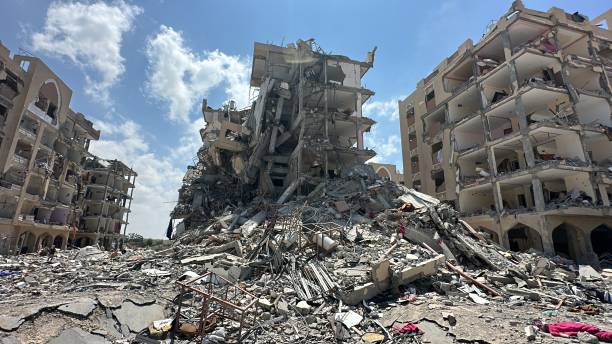
Israeli military operations have resulted in tens of thousands of civilian casualties, widespread destruction of homes, hospitals, and infrastructure, and forced displacement. Reports indicate that over 120 Palestinians were killed in Israeli attacks across Gaza in just the past 24 hours, including many at aid centers. The ongoing blockade has restricted aid deliveries, leading to starvation and worsening health conditions.

Recent reports also indicate that dozens of Palestinians were killed near aid distribution centers in the past few days, as civilians attempted to access food and humanitarian assistance. The Gaza Humanitarian Foundation (GHF), a controversial U.S.-backed organization, has been accused of weaponizing aid and operating under heavy military control, making it dangerous for civilians to receive assistance.

The United Nations has condemned Israeli efforts to dismantle the existing aid system, warning that the new distribution model forces Palestinian civilians into militarized zones to collect rations, further endangering lives. Palestinians are trapped in what can only be called “Hell On Earth.” The UN and humanitarian organizations continue to call for unimpeded access to aid and an immediate ceasefire to prevent further suffering.

In a media-charged world, It is impossible for members of the Global Citizenry to continue to witness the daily starvation and slaughter of innocent Palestinian men, women, and children and continue to Stand-By and do nothing. Silence is complicity. Where do you stand on this issue? The time for action is now and the “Global March to Gaza of pro-Palestinians” is on its way!

The Real-ID Coming To You

Breaking News: Commercial airlines flying over the United States are about to experience economic hardship due to the requirement for all domestic travelers to present a REAL ID.

For those unfamiliar with the REAL ID, here’s what you need to know: It is a federally compliant form of identification that meets enhanced security standards set by the REAL ID Act of 2005. This initiative was introduced to improve the reliability of state-issued IDs following recommendations from the 9/11 Commission.

Beginning May 7, 2025, a REAL ID-compliant driver’s license or identification card will be required to:

  • Board domestic flights within the U.S.
  • Enter federal buildings and military bases.

A REAL ID is marked with a gold star in the upper corner of the card. Some states use different symbols—for example, California places the star inside a bear outline.

If you do not have a REAL ID, you can still use a passport, military ID, or other TSA-approved identification for travel and federal access.

As of 2025, nearly 30% of Americans still do not have a REAL ID. The percentage varies by state, with some states having a significantly higher number of residents without one. Here are the five least prepared states:

  • New Jersey – 61.2% without a REAL ID
  • Pennsylvania – 60.4%
  • Montana – 57.8%
  • Illinois – 52.9%
  • Tennessee – 51.0%

Conversely, the most prepared states include:

  • Delaware – 88.6% of residents have a REAL ID
  • New Mexico – 87.8%
  • Maryland – 86.3%
  • Vermont – 84.4%
  • Indiana – 84.0%

Additionally, some states have a high percentage of residents uncertain whether they have a REAL ID, with Nebraska (20.4%) and Colorado (17.3%) leading in uncertainty.

The deadline for REAL ID enforcement is May 7, 2025, meaning travelers will need a REAL ID-compliant driver’s license or another accepted form of identification to fly domestically.

If you are married and have changed your last name after taking your spouse’s surname, you must provide legal documentation when applying for a REAL ID. This is because the name on your identification must match your official records. If your name has changed multiple times (e.g., due to marriage and divorce), you may need to provide a paper trail of all name changes.

To obtain a REAL ID, applicants must provide:

  • Proof of identity (e.g., birth certificate, valid passport)
  • Proof of Social Security number (e.g., Social Security card, W-2 form)
  • Two proofs of residency (e.g., utility bill, rental agreement)
  • Documentation of any name changes, such as a marriage certificate or court order.

Airlines in the U.S. are likely to face significant challenges due to this mandate. With fewer passengers able to meet REAL ID requirements, airlines may find themselves with an abundance of empty seats—potentially leading to layoffs among airline workers.

In the United States of America, power remains firmly in the hands of the people.


If Elon Musk, the wealthiest person in the world, can threaten to support primary challengers against Republican lawmakers who oppose President Trump’s policies, why can’t American voters leverage their collective vote against Republican lawmakers who fail to uphold the rule of law? They can—and they should. Voters must hold Republican lawmakers accountable by voting them out of office if they fail to defend the American justice system. The power of the American people’s vote is far greater than Elon Musk’s billions.


Musk has been vocal about his political stance, even compiling a so-called “naughty list” of lawmakers who didn’t align with Trump’s agenda. Several Republican senators have expressed concern about facing Musk-funded challengers. Republican lawmakers must decide whether to become Elon Musk’s puppets or to support the wishes of the thousands of voters who have taken to the streets in cities, towns, and hamlets across the nation.


America’s voters, who are already making their voices heard through protests, should also send letters to elected officials, demanding an end to the perversion of our constitutional democracy. It’s not too late for a course correction. However, the dismantling of federal institutions, the brain drain from the federal workforce, and misguided attacks on U.S. colleges and universities could set the nation back for generations.


Regardless of opinions about former President Biden, he left President Trump with a thriving economy that was the envy of the world, a low unemployment rate, and a booming stock market. All Trump had to do was plug minor holes in the system. Protesters shouldn’t just take to the streets—they should contact their legislators through phone calls, emails, letters, social media, town hall meetings, office visits, and advocacy groups. Doing nothing is not a strategy.

Affirmative Access And Equal Opportunity For All Americans


Diversity, Equity, and Inclusion (DEI) policies are designed to promote fair treatment and equal opportunities for individuals from diverse backgrounds. These initiatives aim to create environments where all individuals have access to the same opportunities and are evaluated based on their abilities and contributions, without discrimination. Based on this definition, all Americans should agree to the principles listed under DEI.

The Trump administration forced government agencies to replace anything related to DEI with the so-called MEI framework (Merit, Excellence, and Intelligence). Trump’s merit-based system is a method of evaluating and selecting individuals—typically for jobs, promotions, or educational opportunities—based on their skills, qualifications, experience, performance, and achievements. Again, based on this definition of MEI, all Americans should agree to the principles listed under MEI.

Please, take a close look at both the definitions of DEI and MEI and tell me if you see any discernable differences in their definitions. I am an African-descended American and the only thing my people have ever demanded from our country is Affirmative Access and Equal Opportunities.

Both DEI and MEI call for hiring individuals based on their qualifications and abilities void of discrimination or legacy hiring. Point of Fact: African Americans occupy only 4% of so-called DEI positions in the American workplace. Do your research! Please Share and Comment…

America’s Miss Opportunity – However, It’s Still Time


Breaking News, when President Biden left office, the U.S. economy had both strengths and challenges. On the positive side, the economy had grown steadily during his term, with GDP expanding at an above-average rate, including a 3% growth in President Biden’s final year. Unemployment rates were low, and job creation was robust, with over 15 million jobs added during his presidency. Consumer spending and incomes were robust, contributing to economic growth.

However, there were notable challenges. Inflation surged to its highest level in over 40 years during his term, peaking at 9.1% in 2022 before moderating to under 3% by the end of his presidency. While inflation eased, the cost of essential items like food and housing remained significantly higher than pre-pandemic levels. Additionally, some sectors, like manufacturing, faced ongoing struggles.


So, while former President Biden left behind a growing economy with low unemployment, the lingering effects of inflation and sector-specific weaknesses painted a mixed picture. America had an opportunity to further expand the U.S. economy under President Kamala Harris. America, you missed the opportunity to continue moving the Biden economy forward, however, America is paying for choosing the wrong candidate in the 2024 presidential race. Many voters laugh at the concept of “Bidenomics”; however, they are crying under the so-called President Trump economy.


As we all remember, “Bidenomics” refers to the economic policies and vision of President Joe Biden during his administration. It focused on public investment, empowering middle-class workers, and promoting business competition, contrasting with trickle-down economics. Key legislation included the American Rescue Plan Act of 2021, the Inflation Reduction Act of 2022, and the CHIPS and Science Act of 2022. These policies aimed to boost green energy, domestic manufacturing, and union participation while increasing taxes on wealthy individuals and corporations.


I want to remind Americans that the Trump administration has made significant changes to various departments, including firing experts across fields like science, legal, economic, foreign policy, and environmental sectors and most recently, staff from the National Security Council.
Additionally, there have been mass layoffs at the Department of Health and Human Services, which raised concerns about the future of medical research. The administration also terminated the staff of a program that helps low-income households pay for heating. These decisions were part of broader restructuring efforts, often sparking debates about their impact on public services and governance.


My question to the American voters is, where do we go from here? Now, I know why so many Americans push against so-called wokeness. They wanted American voters to vote with their eyes closed. Let’s be clear, the REAL definition of “Wokeness” is a heightened awareness of social, political, and economic issues. Additionally, the term “woke” meant being alert. If Americans were “Woke” during the 2024 election, we would have a President Harris and a growing economy and would not have a dismantled federal workforce that has made America weak!


Americans still have time to save America’s democracy by (1) Protecting voting rights: Ensuring that every eligible citizen can vote without barriers is fundamental. This includes opposing voter suppression and advocating for fair election practices., (2) Strengthening institutions: Supporting independent judiciary systems, free press, and checks and balances helps safeguard democratic norms. (3) Increase Civic engagement: Staying informed, participating in local and national elections, and holding leaders accountable are crucial. and (4) Building trust: Encouraging dialogue across political divides and addressing misinformation can help rebuild trust in democratic processes.