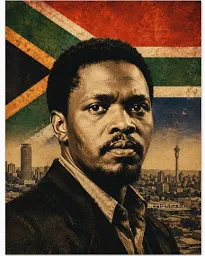
If Steve Biko were alive today, he would insist that South Africa confront the core truth its democracy has not yet resolved: political freedom without economic redistribution is a hollow victory. His philosophy of Black Consciousness was never limited to psychological liberation; it was a call for the restoration of material power to the people who had been dispossessed.
Biko taught that dignity is inseparable from control over one’s economic life. In today’s South Africa, where inequality remains among the highest in the world, he would argue that liberation remains incomplete until the nation addresses material rights, land ownership, and the distribution of wealth. This is not speculation about elections or political outcomes; it is a continuation of the principles he articulated in the 1970s, which many scholars and activists interpret as a demand for structural transformation.
He would likely frame the issue this way: A people cannot be free while the land beneath their feet and the wealth around them remain concentrated in the hands of a few. For Biko, land was not merely a resource; it was identity, security, and the foundation of economic autonomy. Wealth was not merely money; it was the ability to shape one’s future. Without addressing these material pillars, South Africa’s liberation project remains morally unfinished.
I believe that, in Biko’s framework, redistribution would not be about revenge or punishment. It would be about repair, restoration, and constitutional justice, correcting a historical imbalance so that the nation can finally stand on equal footing.
South Africa stands at a crossroads where history demands courage. Steve Biko taught that the greatest weapon in the hands of the oppressor is the mind of the oppressed, and today, the greatest power in the hands of the people is the refusal to accept an unfinished freedom. The struggle now is not for recognition, but for restoration. Not for symbolism, but for substance.
Biko would remind us that liberation is not complete until the people reclaim the material foundations of their dignity, land, wealth, and the ability to shape their own future. He would call on South Africans to stand with the same clarity he demanded in his time: to organize, to speak, to build, and to insist that justice must be lived, not merely promised.
His message for this moment would be simple and uncompromising: Rise. Reclaim what was taken. Restore what was broken. And refuse to inherit a freedom that is only half‑built. The work of liberation did not end with the vote. It continues wherever people insist on their full humanity and refuse to settle for anything less.