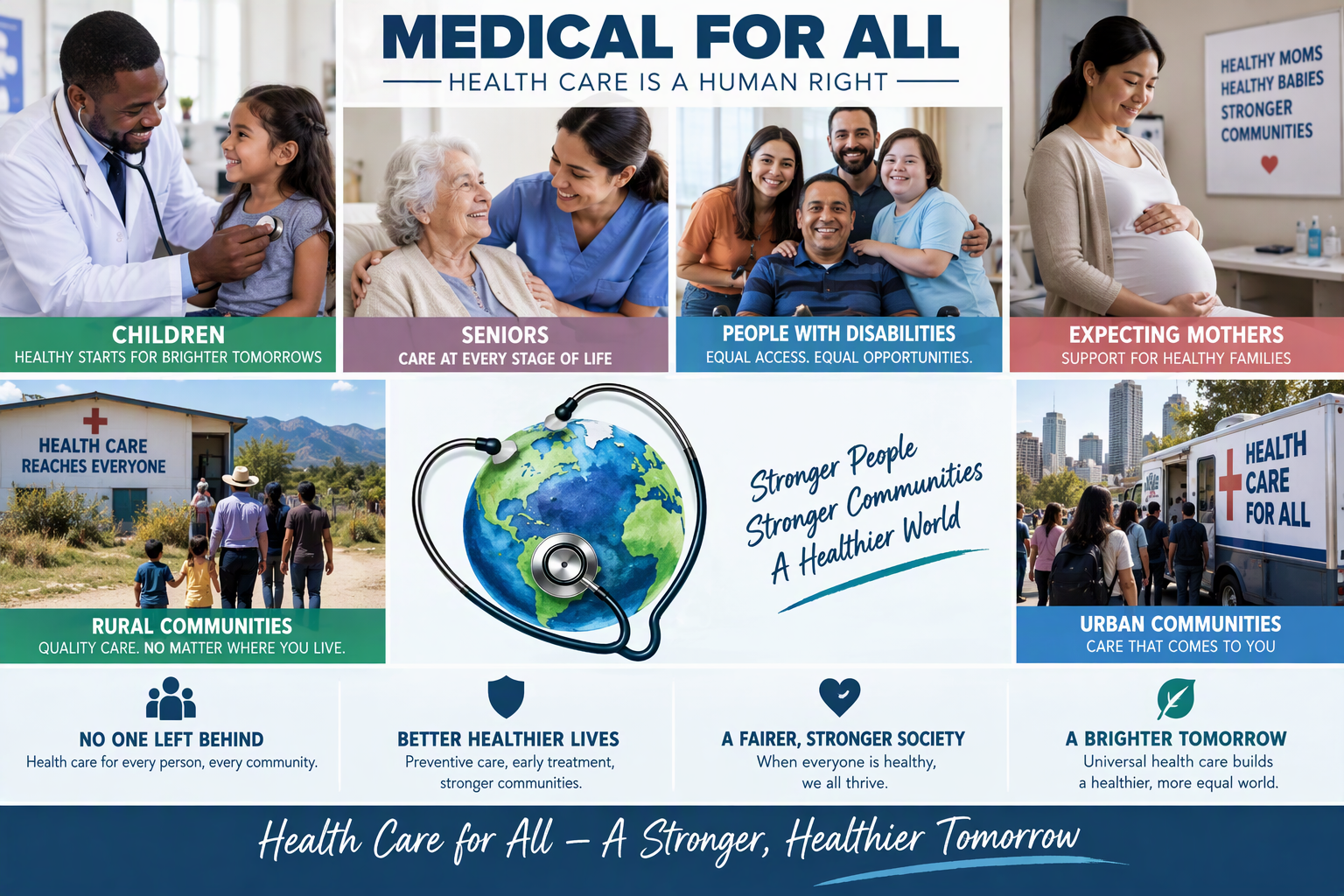
The Question Isn’t Whether We Should Guarantee Healthcare. We Already Do. My fellow Americans, did you know that the United States already has a functioning component of what many call “Medicare for All”? For more than four decades, our nation has operated under a simple but powerful principle: when a person’s life is in danger, healthcare must come before profit.
In 1986, President Ronald Reagan signed the Emergency Medical Treatment and Labor Act (EMTALA) into law. This landmark legislation requires virtually every hospital emergency department in America to provide emergency screening and stabilizing treatment to anyone who arrives seeking emergency care, regardless of their insurance status or ability to pay.
Think about what that means. The United States has already accepted the principle that no human being should be denied lifesaving medical care because they are poor. We have already decided, as a nation, that when a person’s life hangs in the balance, healthcare is a human necessity, not a luxury.
The debate today is not whether that principle should exist. The debate is whether it should stop at the emergency room door. The Emergency Medical Treatment and Labor Act (EMTALA) was America’s First Step. EMTALA was enacted to stop the practice of “patient dumping,” where hospitals transferred or turned away uninsured patients because they could not pay for treatment.
Congress and President Reagan recognized a moral truth that transcends party politics: in a civilized society, people experiencing a medical emergency must receive care. Today, the law applies to nearly every hospital in America because nearly all hospitals participate in Medicare. In other words, Americans already agree on the core principle behind “healthcare for all.” We simply apply it only after a person becomes sick enough to face a crisis.
The Cost of Waiting for a Crisis: According to the Centers for Disease Control and Prevention, Americans make approximately 155 million emergency department visits every year. But emergency rooms are among the most expensive places in the healthcare system to receive treatment.
When people cannot afford “preventive care”, routine checkups, medications, or early intervention, many delay treatment until their conditions become emergencies. By then, treatment is often more complicated, more expensive, and less effective. The result is a healthcare system that spends enormous resources treating preventable crises rather than preventing them in the first place. This makes little sense economically, medically, or morally.
As of today, Millions of Americans remain uninsured; therefore, they have to use the emergency room, the most expensive places in the healthcare system, as their primary doctor. Despite being the world’s wealthiest nation, the “Healthcare Industrial Complex” has prevented Congress from providing “Healthcare For All”!
The National Center for Health Statistics reported that 27.2 million Americans were uninsured in 2024, representing 8.2 percent of the population. That means tens of millions of people continue to face difficult choices between healthcare and rent, prescriptions and groceries, treatment and debt. No family should have to postpone medical care because they fear financial ruin. No parent should have to wonder whether a child’s symptoms are serious enough to justify a hospital bill. And no worker should have to remain in a job simply to keep access to healthcare.
Every Developed Nation Has Found a Way: Across the developed world, nations with different political traditions, cultures, and economic systems have found ways to ensure healthcare access for all citizens. They may not all use the same model. Some rely on public insurance. Others combine public and private systems. But they share a common understanding: Access to healthcare strengthens national productivity, improves public health, and protects human dignity.
The United States should not settle for being a nation where emergency care is guaranteed, but preventive care remains uncertain. Congress must build on what already works! The path forward does not require abandoning American traditions; it requires building upon them.
Again, the Emergency Medical Treatment and Labor Act (EMTALA) already demonstrates that Americans support the idea that medical treatment should not be denied when lives are at stake. The next logical step is expanding that principle upstream, ensuring access to preventive, primary, and ongoing care before illnesses become emergencies.
Congress should examine how the values embodied in EMTALA can serve as the foundation for broader healthcare reform and ultimately a healthcare system that guarantees access for every American. This is a moral test for our nation. The measure of a society is not how it treats those who can afford every advantage. It is how it treats those who are vulnerable, sick, struggling, or in need.
Forty years ago, America made a promise through EMTALA: no one facing a medical emergency would be left to suffer because they lacked money. That promise was right then, and it is right now. The challenge before us is whether we have the courage to extend that same principle beyond the emergency room and make access to healthcare a reality for every American. The foundation already exists. The question is whether we have the courage, compassion, and vision to extend that promise beyond the emergency room and make healthcare a right of citizenship, not a privilege of wealth.